
Monthly RV Living: The Complete Guide to Staying Months, Not Nights
October 1, 2025 · By Magnolia RV Park
Monthly RV living is a different life from RV travel. A weekend trip is about the drive, the campfire, and the next stop. A monthly stay is about the ordinary things: where you buy groceries, how you do laundry, whether you sleep well, and whether the place still feels right in week eight. This guide walks through what changes when your RV stops being a vacation vehicle and becomes your home address for a season or longer.
We run a small, gated, long-term park in Magnolia, Texas, so this guide leans on what we see every day. But most of it applies anywhere you plan to stay a month or more.
Who Chooses Monthly RV Living
People come to long stays for very different reasons, and the reason shapes what kind of park fits best.
- Workers on assignment. Construction, energy, medical, and utility work often runs for months in one area. A monthly site is usually simpler than a short-term rental, and your bed comes with you.
- People between homes. Selling one house and waiting to close on another, relocating for a job, or building a new home can leave a gap of several months. An RV bridges that gap without a lease you cannot get out of.
- Home repair and renovation. When a house is torn up after a storm or during a remodel, living in an RV nearby keeps life moving.
- Downsizers and retirees. Some people simply want a smaller, simpler home with less maintenance and a quieter pace.
- Full-time RVers taking a break from travel. Even people who love moving eventually want to stay put for a while.
If you recognize yourself in one of these groups, you already know your first priority. A worker needs a reasonable commute and quiet nights. A family in transition needs flexibility. A retiree may care most about neighbors and calm.
Monthly Stays vs. Nightly Stays
The biggest difference between a monthly park and a nightly campground is turnover. A nightly park is built for people who arrive late, leave early, and never learn anyone’s name. That is fine for a road trip. It is tiring when you live there.
A long-term park is built for people who stay. That usually means fewer arrivals and departures, more consistent neighbors, rules that protect quiet and appearance, and a screening process before anyone moves in. Some long-term parks, including ours, do not take overnight guests at all. We are not set up as a highway stop, and that is on purpose.
If you are still comparing options, our guide to small RV parks vs. big RV resorts goes deeper into how park size and style affect a long stay.
Choosing the Right Park for a Long Stay
A park you would happily stay in for two nights can be a poor fit for two months. When you evaluate a park for monthly living, look past the photos and ask about daily life.
Location that works on a Tuesday
Think about your real routine: work, groceries, pharmacy, fuel, and appointments. A park that is scenic but far from everything can wear you down. A park beside a freeway can be convenient but loud. In our area, Magnolia sits in Montgomery County northwest of Houston, with local roads like FM 1774 and FM 1488 and Texas 249 leading toward Tomball, The Woodlands, and the wider Houston area. Drive your likely commute once before you commit.
Site surface and cover
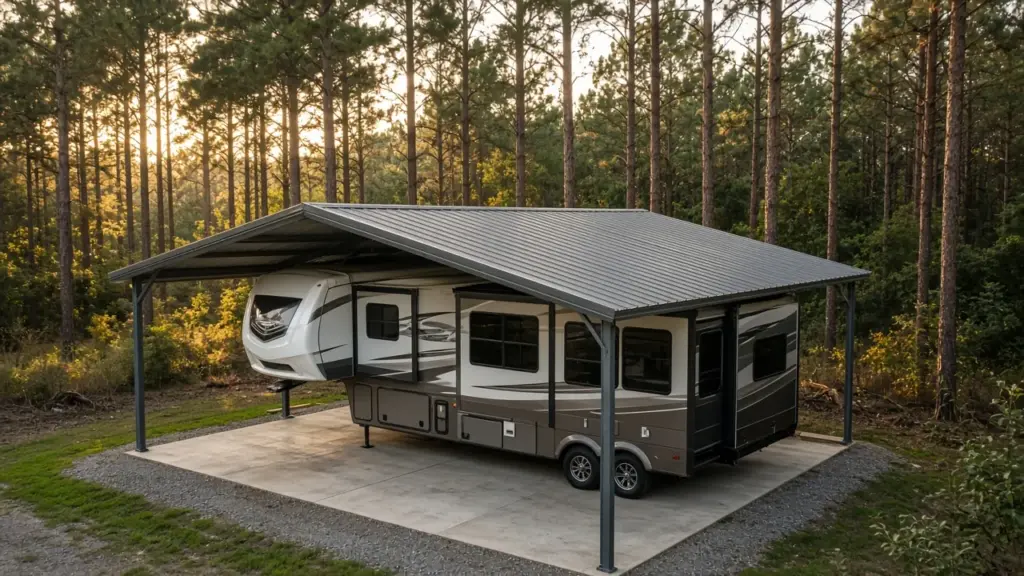
For long stays, the site itself matters more than any amenity. Concrete pads make leveling easier and keep mud out of your rig. Covered sites help with sun and weather, which is a real consideration in a Texas summer. At our park, all ten sites are on cement pads and eight of the ten are covered. See Sites & Rates for how the sites are laid out.
Rules and management
Rules tell you what daily life will feel like. Quiet hours, pet policies, guest limits, vehicle rules, and what can be stored outside all shape the atmosphere. A park with clear rules and consistent management tends to stay calm. Read the rulebook before you apply, not after.
Honest answers about utilities and pricing
Ask directly about electric service, water, sewer, and internet for the specific site you are considering. Good parks confirm these details rather than making promises on a website. The same goes for monthly rates: many small parks quote current pricing by phone because it can depend on the site.
Budgeting for Monthly RV Living
Monthly RV living can be economical, but only if you plan for the full picture. Site rent is only one line. Also think about:
- A security deposit and any application or screening fee
- Electricity, propane, and any other utilities you are responsible for
- RV insurance, including liability and property coverage
- Maintenance and repairs, which do not stop because you are parked
- Mail forwarding, storage units, and phone or internet plans
- Fuel for commuting and errands
We cover the money side in detail in our guide to full-time RV life on a budget. In brief, keep a cushion for surprises, because RVs always find a way to need something.
Setting Up Your Site for the Long Haul
Setting up for a month is not the same as setting up for a night. Take the time to do it right on day one, and you will not be redoing it in week three.
- Level carefully. A well-leveled RV is better for your refrigerator, your slides, your doors, and your sleep.
- Protect your electrical system. A good surge protector is worth using at any site.
- Use a pressure regulator and a drinking-water hose. These small parts prevent a lot of problems.
- Set up sewer connections neatly and securely. A clean, supported hose is easier on you and your neighbors.
- Organize the outside. Long-term parks usually limit what can sit on or under your site. Keep it tidy from the start.
Our long-term RV living checklist is a handy printable companion for move-in week.
Daily Life: Routines That Make It Work
The people who enjoy monthly RV living tend to build simple routines. They do laundry on a set day, keep the kitchen clear, take the trash out often, and check the rig’s exterior every week or so. Small spaces reward small habits.
A few routines worth adopting early:
- A weekly walk-around. Look at tires, seals, the roof edge you can see, and anything that looks loose.
- A moisture plan. Cooking, showers, and breathing add humidity. Run vent fans and watch for condensation, especially in cooler months.
- A storage reset. Once a month, take out anything you have not used and decide whether it earns its space.
- A quiet-hours rhythm. Most long-term parks set quiet hours. Ours run from 8 p.m. to 8 a.m. That rhythm is part of what makes a small park restful.
Understanding Park Rules
Rules can feel strict on paper, but in a long-term park they are what keep the place pleasant. At Magnolia’s Finest, the rules include limits of two people, two pets, and two vehicles per site, a 10 MPH speed limit, no extensive mechanic work or vehicle washing, and a requirement that RVs be fully self-contained, in good condition, and 15 years or newer. You can read the full list on our park rules page.
The best approach is simple: read the rules before you apply and ask about anything unclear. If a rule does not work for your household, it is far better to know before move-in day.
Applying and Moving In
Long-term parks typically ask for more information than a campground. Expect questions about occupants, vehicles, pets, your RV, and insurance, and expect a background check. That screening is part of why long-term parks stay quiet and safe.
Our process is straightforward: check availability, apply if a site may work, complete the background check, then send the deposit once approved. Nothing is reserved until the application is approved and the deposit is received. We walk through each step in our guide to applying to a long-term RV park.
On move-in day, arrive early. We ask that RVs arrive before 6 p.m. so you can set up in daylight. If you are coming from out of the area, our post on moving to Magnolia, TX with an RV covers the order of operations.
Signs Monthly RV Living Is Right for You
Monthly RV living suits people who value simplicity, do not mind a compact kitchen, and like knowing their neighbors without living on top of them. It is less suited to people who need lots of storage, host frequent overnight guests, or want resort-style entertainment on site.
If you are unsure, start with a defined window, such as a single work assignment or the months until a house closes. You will learn quickly what you love and what you would change.
More Monthly RV Living Guides
- Monthly vs. Nightly RV Park Stays: How the Experience Differs
- How Long Is Long-Term at an RV Park? Weekly, Monthly, and Extended Stays
- Your First Week at a Monthly RV Park: A Day-by-Day Settling Plan
- Setting Up an RV Site for a Months-Long Stay
- What to Leave Behind When Moving Into an RV Long-Term
- Downsizing a House Into an RV: A Room-by-Room Approach
- Living in an RV While Your House Is Being Built
- Living in an RV During a Home Renovation or Insurance Repair
- RV Living Between Homes: Using a Monthly Site as a Bridge
- Is Long-Term RV Living Right for Retirees?
- Long-Term RV Living as a Couple: Space, Routines, and Privacy
- Staying in One RV Park Through All Four Seasons
- Daily Routines That Make RV Living Feel Like Home
- Making a Small RV Feel Bigger for a Long Stay
- Storage Solutions for Full-Time RV Residents
- Cooking in an RV Kitchen Every Day
- Keeping an RV Clean When You Live in It
- Laundry Routines for RV Residents With an On-Site Laundry Room
- Managing Condensation Inside a Lived-In RV
- Receiving Packages and Deliveries at an RV Park
- Staying Healthy in RV Life: Sleep, Space, and Movement
- Working Remotely From a Long-Term RV Site
- How to Know When It’s Time to Renew Your Stay or Move On
- What a Quiet RV Park Is Really Like Day to Day
- Long-Term RV Living Mistakes First-Timers Make
- Travel Trailer, Fifth Wheel, or Motorhome for Living Long-Term
- Why Long-Term RV Parks Set RV Age Limits
- Concrete RV Pads: Why They Matter for Long Stays
- Sleeping Better in an RV: Mattresses, Noise, and Light
Frequently Asked Questions
What is the difference between a monthly RV park and a campground?
A monthly RV park is built for residents who stay for weeks or months, with screening, rules, and consistent neighbors. A campground is built for short visits and frequent turnover. Some long-term parks do not accept overnight guests at all.
Do long-term RV parks require a background check?
Many do. At Magnolia’s Finest, a basic background check is required as part of the application. Screening helps keep a small community quiet and safe for everyone who lives there.
Are utilities included in monthly RV site rent?
It depends on the park and sometimes on the site. Always ask management directly for the current arrangement for electric, water, sewer, and internet rather than assuming from a website.
How far ahead should I look for a monthly RV site?
As early as you can. Small parks have few sites and long stays, so openings may be limited. If a park is full, ask whether it keeps a waitlist.
Can I live in an older RV at a long-term park?
Many long-term parks set an age or condition standard. Ours accepts fully self-contained RVs or motorhomes in good condition that are 15 years or newer.
Ready to Talk About a Monthly Site in Magnolia?
Magnolia’s Finest is a quiet, gated, ten-site park with eight covered sites, cement pads on every site, and an on-site laundry room. We focus only on long-term guests. Tell us your dates, your RV, and whether you would like a covered pad, and we will let you know what may be available. Learn more about long-term RV living in Magnolia.
Check Availability or call or text (281) 205-1959
Magnolia’s Finest RV Park · 32020 Old Hempstead Rd, Magnolia, TX 77355 · Contact us